
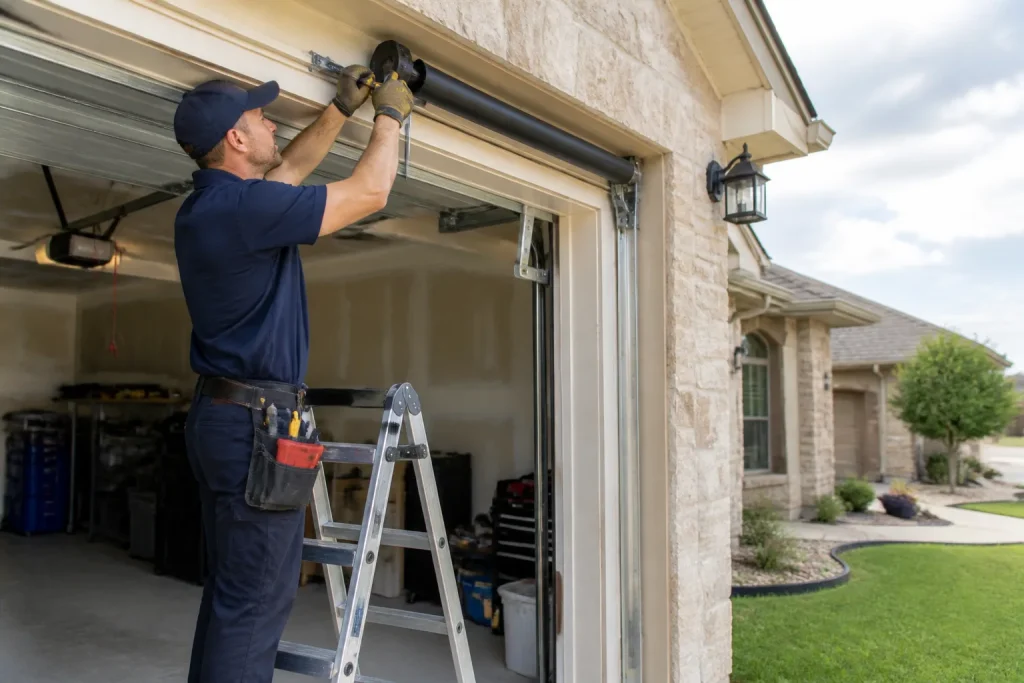
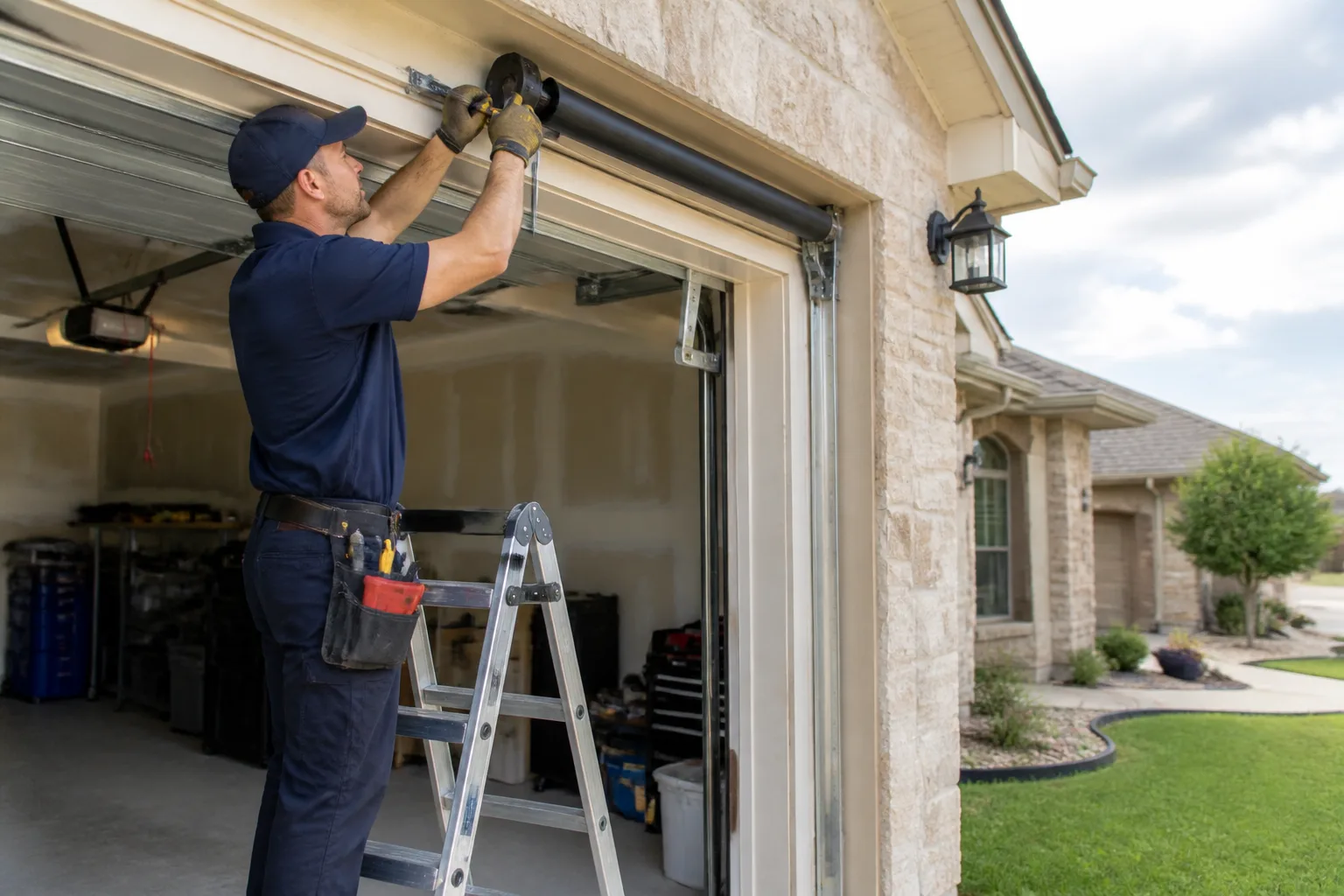
Craftsman Garage Door Repair in Midland: A Homeowner’s Guide
Most Craftsman opener problems in Midland aren’t motor failures. They’re calibration problems, logic board quirks, or a keypad that lost its pairing after a power blip, and a lot of homeowners replace a perfectly good unit because a generic YouTube fix told them to. The catch is that “Craftsman” covers several different machines under one name, and the repair logic changes with the generation. If you’d rather not chase it yourself, call (844) 904-1321 and we’ll diagnose it properly.
Which Generation of Craftsman Opener Do You Actually Have?
Craftsman openers sold through Sears, and later through Lowe’s, share a name but not a single parts ecosystem. The model number on the unit’s label is what tells you which machine you’re dealing with, and it changes every repair decision downstream. There are roughly three families you’ll run into in Midland garages: early units built on Stanley hardware, a long middle run using Chamberlain internals, and the newer third-generation hybrid designs that mix platforms under one housing.
Here’s how to find out which one you have:
- Find the label on the back panel or under the light lens. The model number starts with a prefix that identifies the platform, and the serial carries a date code.
- Note the wall control style. Legacy three-button panels usually point to older platforms; units with a smart-home pairing button lean newer.
- Check for a battery backup compartment. Craftsman introduced DieHard battery backup models after 2015, and that housing is a strong tell for the newer generation.
- Write the full model and serial down before you call anyone, including us. It saves a trip and it’s the first thing any competent technician asks for.
Why does this matter in Midland specifically? Because parts sourcing here depends on the platform, not the brand name on the housing. A rail assembly or logic board for a Chamberlain-based Craftsman isn’t the same part as one for a Stanley-era unit, and ordering the wrong one is the most common reason a repair drags out over multiple visits. Get the model number right and everything after that gets simpler.
The Three Craftsman Failures We See Most Often
In our experience, the majority of Craftsman service calls in Midland come down to three specific failures, and two of them look far worse than they are.
- Logic board resets that mimic major malfunctions. A Craftsman board that takes a voltage dip can lock itself into a strange state: the door runs a few inches and reverses, the light strobes, or the opener ignores the wall control entirely. It reads like a dead motor. Often it’s a board that needs a proper reset sequence, or a board that’s genuinely failed and needs replacement. The reset is the cheap first step; diagnose before you buy.
- Travel limit drift. The opener “forgets” where the door should stop, so it reverses before closing or slams and reopens. On Craftsman units the limit settings live in the head unit and drift over time with temperature swings and normal wear. This is a calibration job, not a motor job.
- Keypad pairing failures on 139.x series units. The outdoor keypad stops accepting the code, or the remote and keypad fight over the same channel. On the 139.x series this is usually a pairing procedure problem, not a dead keypad. Re-pairing in the right order fixes it more often than replacement does, and a replacement keypad paired wrong will fail the same way.
None of these require a new opener. All three require someone who knows the Craftsman sequence, which is a different thing from knowing garage doors in general.
Why the Force Adjustment Trips Up Craftsman Owners
Craftsman openers use a force adjustment system that tells the motor how much resistance to push through before it reverses for safety. When that setting drifts, or when a homeowner turns it up to “fix” a door that’s binding, the opener starts behaving like a failing motor: it strains, it stutters, it reverses halfway. The natural conclusion is that the motor is dying. Usually it isn’t.
What’s actually happening is one of two things. Either the door itself has developed resistance (a dry roller, a binding track, a spring that’s lost tension) and the opener is doing exactly what it should by struggling against it, or the force setting is simply wrong for the door’s weight and the unit is over- or under-compensating. Cranking the force up to force the door closed masks the real problem and wears the motor faster. Cranking it down creates false reversals.
We’ve seen this misdiagnosis lead to motor swaps on units that were mechanically fine. The right sequence is to check the door’s balance and travel first, then the force setting, then the motor. In Midland, where doors cycle hard through hot summers and mild winters, the door hardware usually deserves the first look. A binding door is a door problem wearing an opener costume.
One safety note here: the force setting and the safety reverse are what stop the door on contact. Don’t disable or max out either one to make a stubborn door behave. If the door won’t reverse on a test block, stop using it and get it looked at.
Parts Availability for Craftsman in Midland
Here’s the honest reality of sourcing Craftsman parts in Midland. Common wear items, remotes, keypads, safety sensors, and standard hardware are generally available without much wait. Logic boards, rail sections, and gear assemblies vary by generation. The Chamberlain-based units are the easiest to source for, because that parts ecosystem is deep and well supported. Stanley-era hardware is where things get thin, and some of those components have to be tracked down or substituted rather than bought off a shelf.
The newer DieHard battery backup models sit somewhere in the middle. The backup battery itself is a wear item and replaceable. The board and motor assemblies are generation-specific, and availability depends on the exact model year.
Obsolescence is the real question. A Craftsman unit crosses into obsolescence territory when its logic board or motor assembly is no longer produced and the only path is a used or salvaged part. At that point you’re weighing a repair with uncertain parts against a replacement with a known outcome. That’s not a decision to make on the phone with a parts clerk. It’s a decision to make with someone who can look at the unit, confirm the part situation, and tell you which way the math actually goes. We work across Craftsman and the other major platforms (Chamberlain, Genie, Clopay, Amarr among them), so we’re not motivated to steer you toward replacement just because we can’t source one brand.
Repair or Replace? When Craftsman Repair Stops Making Sense
Craftsman repair is the right call when the failure is calibration, a pairing issue, a sensor, a remote, or a board that’s still in production. Those repairs are contained, and the unit has years left. It’s also the right call when the door itself is sound and the opener is the only variable.
Replacement starts making sense when three things stack up:
- The unit has crossed into obsolescence and the needed part is no longer produced.
- The repair estimate approaches the cost of a modern unit with current safety features and smart-home capability.
- The door hardware is also aging, so you’re repairing an opener to lift a door that’s about to need its own work.
When that happens, a brand-agnostic replacement is the smarter long-term decision, and it doesn’t have to mean abandoning the Craftsman name if you like it. What it means is choosing a platform with a deep parts ecosystem going forward, so the next repair is a sourcing non-event. We install openers as well as repair them, which means we can give you a straight answer on which path costs less over the next several years, not just which one bills more today.
When to Call a Pro
Call a specialist when the opener behaves unpredictably after a reset, when you’ve had to adjust the force setting more than once, when a keypad won’t pair after two honest attempts, or when the model number points to a generation where parts are uncertain. Those are all cases where a wrong guess costs more than a diagnosis. The high-voltage wiring inside an opener and the springs and cables on the door are not DIY territory. Trained hands, every time.
Related services in Midland
If your issue turns out to be the door rather than the opener, our garage door repair team covers panels, tracks, rollers, and springs. If it’s the opener itself, our garage door opener repair handles Craftsman and the other major platforms. And if you want the full picture of what we do across Midland, the Nautilus Garage Door Repair home page lays it out.
The Bottom Line
Craftsman openers last longer than most homeowners expect, but the repair logic is brand-specific, and the model number on your unit is the key to everything that follows. Logic board resets, travel limit drift, and 139.x keypad pairing problems are usually calibration issues, not motor failures. Force adjustment misreads lead to unnecessary motor swaps more often than any other single cause. And when a Craftsman crosses into obsolescence territory, the right call is a brand-agnostic replacement rather than a repair with uncertain parts.
If you’re in Midland and need help, Nautilus Garage Door Repair offers free estimates. We answer 24/7, with fast dispatch from 7am to 7pm, Sunday through Friday. Call (844) 904-1321 for a free estimate, and the price is quoted and agreed before any work starts.
Frequently Asked Questions
Check the model number on the label on the back panel or under the light lens. The prefix identifies the platform: early units on Stanley hardware, a long middle run on Chamberlain internals, and newer third-generation hybrids. A battery backup compartment points to the DieHard models introduced after 2015. Call (844) 904-1321 if you can’t find the label, and we’ll walk you through where to look.
Probably not. That pattern usually points to a logic board reset state, travel limit drift, or a door that’s binding and triggering the safety reverse. The motor is the last thing to suspect, not the first. Call (844) 904-1321 for a diagnosis before you buy a motor.
Common wear items, remotes, keypads, sensors, and standard hardware are generally available. Logic boards and gear assemblies depend on the generation: Chamberlain-based units are the easiest to source for, and Stanley-era hardware is the thinnest. If the part is no longer produced, we’ll tell you straight and lay out the repair-versus-replace math. Call (844) 904-1321 for a free estimate.
Repair is the right call when the failure is calibration, pairing, a sensor, or a board still in production. Replacement makes more sense when the part is obsolete, the estimate approaches a new unit, or the door hardware is also aging. We install as well as repair, so we can give you the honest comparison rather than pushing one path. Call (844) 904-1321 and the written estimate sets the price.
Written by the team at Nautilus Garage Door Repair.
Need Garage Door Help?
Call Nautilus Garage Door Repair - licensed & insured, here with fast help in Midland.
(844) 904-1321